
Exploring Euclideon's Unlimited Detail Engine
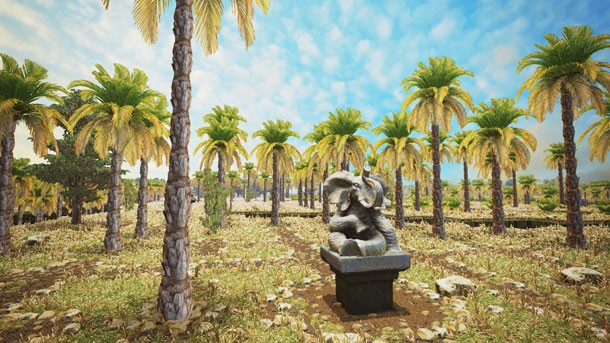
Is the Australian-developed Unlimited Detail technology the future of gaming? Or is it just a scam? We invited Euclideon CEO Bruce Dell to our office to prove his claims by letting us go hands-on. He was happy to oblige.
The following article was originally published in issue 22 of Game Informer Australia, and was written by contributing editor Adam Mathew. For a bit of background on Euclideon's claims, as well as a video of the original tech demo the company released this summer, check out our original news article.
Up and Atom
Fledgling Australian company Euclideon recently ignited
YouTube and the international gaming industry with a short teaser of its
Unlimited Detail 3D engine. Its claim: using an unconventional "atom based"
approach to building 3D worlds, this new technology can increase the current
visual fidelity of graphics by 100,000 times. Can it be true?
Skepticism furrowing my brow, I invited the Wollongong born-and-bred CEO of the company, Bruce Dell, into the office to discuss Unlimited Detail, respond to his critics, and to go hands-on with the tech. I wanted to gauge its potential for myself and, in truth, to try and break it. To make sure there was no smoke and mirrors.
I had a basic idea of what to expect. Most of the computer graphics that we enjoy in games today are based on polygon systems, with all the objects in the world built out of flat little shapes. But Unlimited Detail forgoes these flat panels by building everything in the world out of tiny little atoms, more commonly known as "voxels", the three-dimensional equivalent of pixels.
"In the graphics industry, everyone is used to using polygons, so we thought we'd build a polygon converter," Dell explains. "So by converting regular polygons into Unlimited Detail (or 'point cloud data'), you can then run them in unlimited quantities. At present, we're converting polygons at a rate of 64 atoms per cubic millimeter. Not sure how small that is? It's a rate of 1,000,000 atoms per cubic inch."
Better yet, Dell claims that this process, called the "Unlimited Detail algorithm" is so efficient, it can run capably on anything from a PC to a mobile phone with no graphics card required.
Understandably, the suggestions of "unlimited graphics power" made by Euclideon were met with considerable amounts of excitement, but also a lot of cynicism and, in some cases, outright abuse. It's due to this reaction that I have insisted that I get a real-time, hands-on demonstration of the technology.
But I'm after more than just an explanation of how this revolutionary idea works: I wanted to learn how an Australian from a coastal town just south of Sydney came up with such an out-of-the-box concept for the future of graphics processing. A concept that is currently polarizing and flat-out confounding his classically educated computer scientist peers.

Euclideon's logo isn't just a logo...
Big Brain on Bruce
Suggesting he's a computer scientist, or at least a
university alumni in the field, proves to be a mistake: Dell is quick to point
out that he holds no such uni degree, nor anything approximating it. Seeing my
eyebrow rise – and being well aware of the "snake oil salesmen" accusations leveled
at him by Minecraft creator, Markus "Notch" Persson – Dell quickly explains
that his lack of a tertiary education is core to his success.
"Not going to uni isn't something people should be proud of – and I don't want to disrespect unis because they're necessary and good," he disclaims without skipping a beat. "But there is a pattern, historically speaking, between inventing new things and being disconnected from the established way things are done."
Dell went on to explain why being sheltered from schools during the early '90s evolution of 3D gaming was a massive boon. It meant he avoided the temptation of easy answers. Whenever he encountered a problem with his own budding 3D engine, he was forced to solve the riddles himself, rather than plucking the accepted solution from a textbook. His self-taught approach created a unique schism between how he imagined the innards of a 3D engine ought to work, and what others were collaboratively accepting and creating elsewhere.
Dell attributes two things to the genesis of Unlimited Detail during that period: a big misunderstanding, and a hobby that spiraled into an obsession. 17 years ago, Dell was an avid coder hobbyist of 2D games on his Amiga 500. He had created quite a few basic games for himself and his family, but his world was rocked, like many at the time, by the release of one particular SNES game with landmark graphics.
"Do you know what started all this?" Dell confides. "Donkey Kong Country. When that first came out I made the mistake of thinking that [Rare was using] real-time 3D processing. Obviously they were just using pre-rendered sprites, but as a start-up 2D coder I was utterly dismayed. I thought 'oh no, I can't compete with this. I'm not smart; I'll never be able to do this.' Then one day I had a weird idea in my head [Unlimited Detail] and I looked at it and thought: I wonder if that would make similar 3D?"
After three years and a lot of stubbornness, Dell says he finally had some primordial-looking, but functional 3D working on his humble Amiga. Better yet, he realized that the way he had achieved it was quite unlike anything else out there. After ten more years of reinventing 3D graphics he assures me that the fateful seed planted by Rare, via Donkey Kong Country, has all but fully germinated into a radically different type of graphics middleware that has obvious advantages over what we use today.
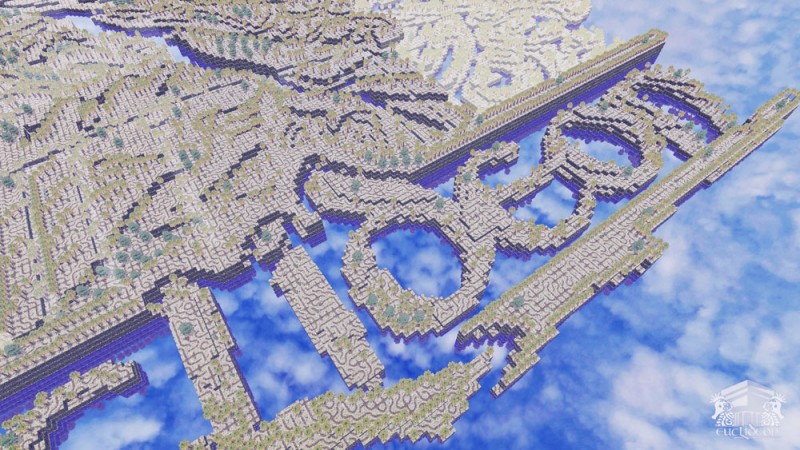
It's actually comprised of tiny islands...
Going Hands-On
As soon as I begin exploring a world rendered in Unlimited
Detail, my opinion upgrades from cautiously optimistic to extremely impressed.
I'm allowed to delve into the "Euclideon island" demo that Dell revealed on
YouTube in August.
The company logo appears on the screen and it's only when I zoom in that I realize it's actually a bird's-eye view of a one-kilometer-squared system of islands populated by trees, ancient ruins, and other accoutrements of nature. Using a repurposed 360 controller, I'm amazed at the speed in which I can zoom, pan, and travel from this space-based view to anywhere I please.
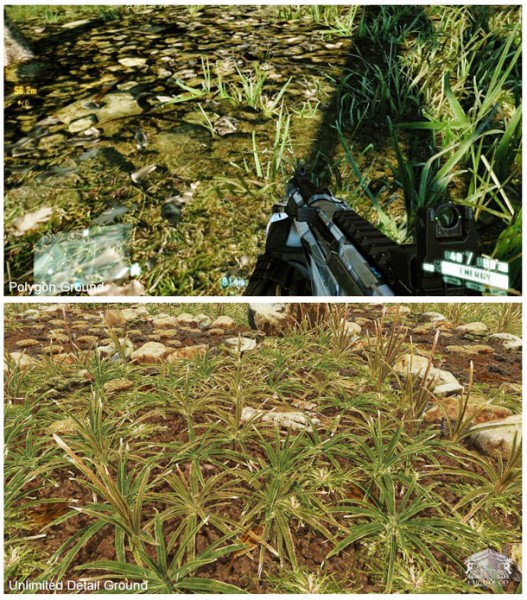
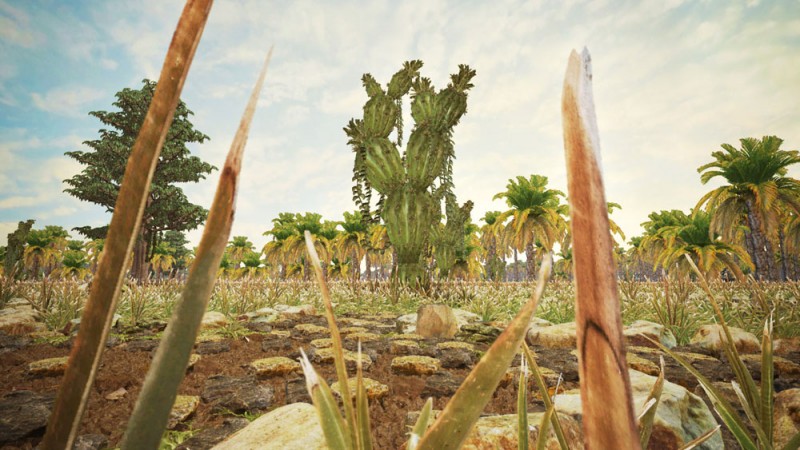
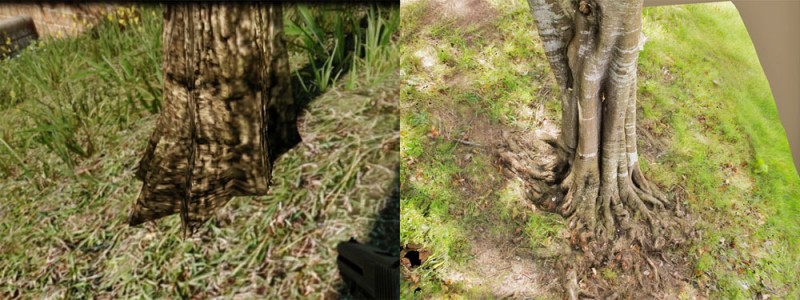
Searching for shortcomings in the system, I super-magnify the camera to a level that offers a view of intricately detailed, individual dirt granules as some impossibly high-fidelity grass towers above me. It's like I'm 50-years into the future and starring in a movie tie-in for Honey I Shrunk The Kids. Dell catches the look of wonderment on my face and reassures me that there's no witchcraft involved. There's also none of the detail trickery seen in other engines, where objects are secretly swapped out for versions with lower and lower geometry as the camera moves away.
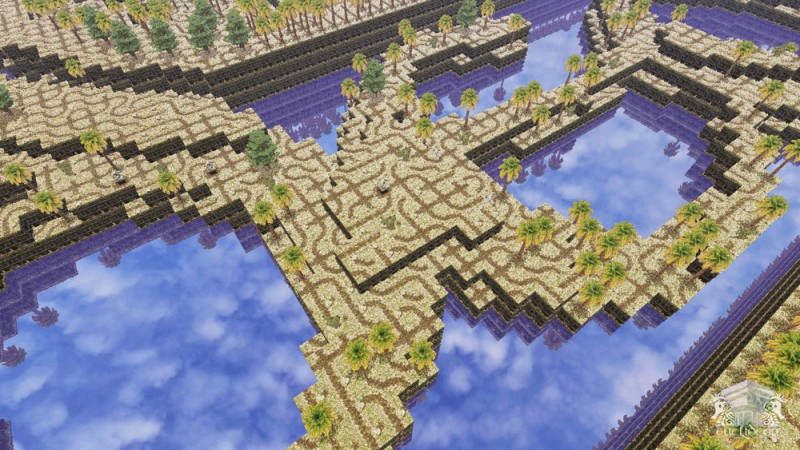
Each containing a startling amount of detail...
No, the massive, open-world "logo" that I'm gallivanting across is comprised of (if you were to convert the atoms back the other way) 21 trillion polygons. Just the square meter of ground I'm "standing" in – with its photorealistic dirt, grass clumps, and odd bits of bark and leaves – is comprised of 20 million polygons. In comparison, the average square meter of ground in a game like Bulletstorm might have 15 polygons, if that.
Just as I'm wrapping my head around those mindboggling numbers, Dell offers to show me some sneaky smoke and mirrors, but it's not in the form of devious cheatery. The islands that comprise the logo are reflected in what appears to be perfectly still water. Using the camera to travel down "into" the blue, I realize that there is no reflection or water at all: it's a complete duplicate of the terrestrial islands, flipped vertically, pasted on underneath and tinted blue.
Dell tells me that this was done because they - and by "they" he means the lone artist on his team - had to build this huge world in the three weeks before Gamescom. He also confirms that while the "regular" side of the island is 21 trillion polygons, the addition of the duplicate "underwater" version hiding beneath really means his half-finished engine is currently, and effortlessly, throwing around 42 trillion polygons.
"To solve the water problem like that with polygons would be the biggest, most inefficient mistake ever thought of," says Dell. "But if you've got unlimited power, only three weeks and you need some 'reflective water,' it makes perfect sense."

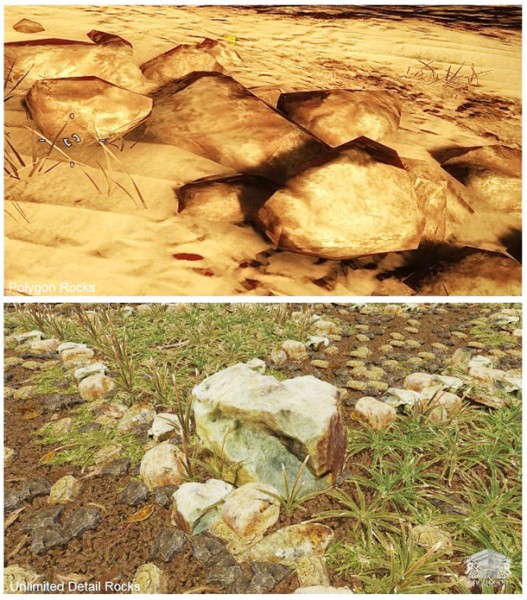
The detail extends down to individual rocks
This is Heavy
So I'm pretty impressed: it's hard not to be, especially
when I'm told the demo I am experiencing is running purely in software. The
Unlimited Detail system is so efficient the team hasn't had the need to tap the
GPU at all.
"Most technical people who see this demo are like 'gasp! This is unbelievable – how is this able to be done?'" says Dell with a smile. "So let me explain away the mysticism.
"If I had one object on the screen, say one little teddy bear spinning around, you wouldn't find that to be particularly amazing. But if I were to take a teddy bear's worth of atoms, unwrap it, and cover the whole screen, we'd get one screen's worth of atoms. Now, even though you're seeing stuff in this demo that looks like unlimited geometry, people had always theorized that there might be a way – and there was, we found it – to make computers very, very efficient in grabbing exactly what was needed."
In effect, what Dell has discovered is a search algorithm that only grabs one atom for each pixel on whatever your screen's resolution is. Even though it looks like a lot of stuff, what you're actually viewing is a way of looking at just one atom per pixel. So you end up with the same amount of atoms as if you were looking at one object, but the way they're used at exactly one atom per pixel gives maximum efficiency. This is the secret to what Euclideon is calling "unlimited power."
A slightly more technical explanation of Unlimited Detail is that it's a Point Cloud Rendering system, which uses a large number of individual points to create models, instead of a more traditional polygon mesh. The engine uses a search algorithm to determine which of these points are to be made visible on-screen, and then only displays these points: so on a 1024x768 display, for example, the engine would only show 786,432 visible points in each frame.
As the engine is displaying the same amount of points in every frame, the level of geometric detail provided is limited only by the amount of memory needed to store the point cloud data.
Unsatisfied with what is on show, Dell reminds me that his work is only half finished and even apologizes for how the demo ran (it seemed like at least 25 fps to me). "At this particular time we have not hooked up the memory compaction, so while the memory is far from shameful, it's not how the final product will be. Plus it's 10% slower because this laptop isn't plugged in."
He also apologizes for the repetition of objects: due to the aforementioned three week deadline and only having one artist, Dell says that the demo doesn't look "artistically amazing" because they relied heavily on the 3D laser-scanning of a handful of real-world objects. For example, that elephant statue you see in the screenshots is at home on his coffee table, the goddess statue is a garden fixture, and the rocks are from a park near the company's Brisbane offices.
Dell openly acknowledges that the online opponents of Unlimited Detail have zeroed in on the object repetition as some sure sign of technical weakness. Some have suggested that, "the Achilles heel of this system is that it is limited to 'X' number of unique objects." Dell laughs it off and says that no such drawback exists. He mentions that, for the next tech demo they plan on releasing, Euclideon has engaged the services of some ex-THQ staffers to provide actual art, rather than relying on rushed laser scanning.
A Jealous Industry?
With the topic of negative reactions raised, I take the
opportunity to get Dell's thoughts on how many respected industry gurus, and
the public, have reacted to his claim that Unlimited Detail will improve
graphics by 100,000 times.
"Response to the tech has been more positive than anything, and we're bigger news in Germany than we are elsewhere" he replies, evenly. "The German [gaming journalists] that saw this at Gamescom didn't announce this as a new and interesting technology: they announced it as 'perfect computer graphics are among us, and this is what will happen in the next few years.' They reported with authority that polygons, in their conventional form, are gone and they will be converted to atoms."
Notch accused Euclideon of releasing the YouTube video just because "they want funding." Dell says that before the video was even posted Euclideon was flush with funds thanks to a grant of almost $2M from the Aussie government (the largest grant awarded by the Federal Government under its new Commercialisation Australia initiative). He also says that Euclideon has the backing of "the Bill Gates of Australia."
That man is David Merson, the ex-CEO of Mincom whose 21-year reign at that company oversaw its rise to be Australia's largest software developer. Money clearly doesn't seem to be an issue. In fact, Dell said that Euclideon regularly "knocks back money from investors" partly because they don't need any more, but also to maintain secrecy about the inner-workings of their tech.
It's interesting to note that at this very same convention, the head of Crytek, Cevat Yerli, didn't think that Euclideon was peddling a hoax. In fact, he went so far as to say he "really respects [Euclideon] for getting so far" and that "Unlimited Detail [is] absolutely believable." He mentioned that his own team implemented Point Cloud Rendering in Far Cry to create a tiger. However, at the time it was simply too slow to work in a game. Lastly, he points out that in his keynotes in the past he always talked about how such a technology could be a possible future.
Moving from the positive reactions, I remind him of some of the "fence-sitter" opinions coming from his peers. In particular, comments from the eminently talented John "creator of the FPS" Carmack at id Software, who openly suggested a system like Euclideon's was possible in theory, but probably only in about five years time.
"[Carmack] was unaware at the time that we were running this purely in software," Dell responds. "In his particular case, he and Intel had tried to go down a similar road themselves. Intel had tried making its own system in order to do things along the field of unlimited graphics. It ended up closing that avenue as it figured it was something for the distant future when computers have more power."
Dell also makes mention that Carmack had attempted a similar experiment – three times, to the best of his knowledge – but also came to the conclusion that it was a project to shelve for five or so years until computers had more power to support it. "In our case," he says with a grin, "we managed to do it a little bit earlier."
Then of course there is Minecraft creator Notch, who made some extremely negative comments towards both Dell and the validity of his work. "My opinions on Notch are two-sided," he says with an exaggerated exhale. "On the one hand, I could be nice and say, 'yes, there are scammers out there – it's fair enough to look at something and immediately label it as a scam.'"
"But on the other – which people have brought up – the man compared [Unlimited Detail] to three other engines [that he assumed Euclideon had just copied and labeled as their own]. The examples he suggested were so incorrect you'd have to be pretty disconnected from 3D graphics to make the mistakes he made. Like, he said, 'if their demo was real and you added up all the little atoms in the island then it would use this many petabytes of data.' But everybody knows that if you see a tree twice it's reconnected. There isn't a game that I know of that doesn't use the same object twice and I assure you that they didn't store that object two times separately."
It's obvious that Dell is taking no pleasure in correcting his harshest critic, but he presses on his own defense. "There were other things he said too, like this is just an Atomontage engine. But that's just a physics engine, for a limited number of points. It only shows tiny things like pot plants, or smallish plots of sand. The mistakes Notch made were so bad that, if we were less kind, we would be able to really discredit his actual understanding of a lot of stuff in general. But that's honestly not our intention: we don't want to make enemies with him. We prefer to bring him around and be nice to him."
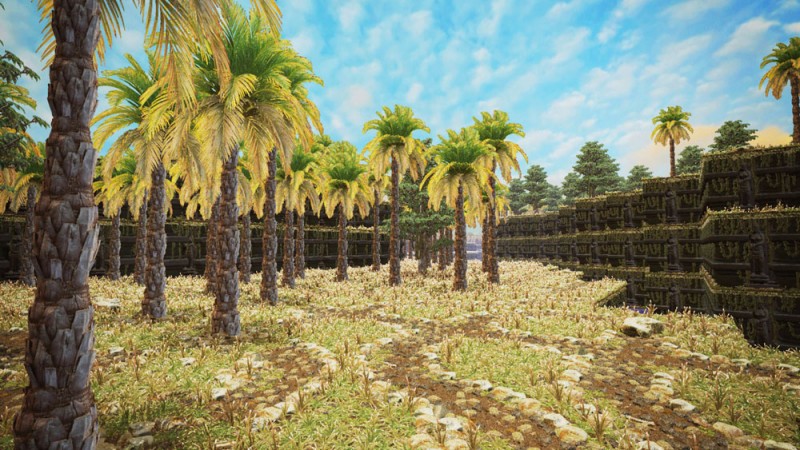
This scene is still within the same structure made up of thousands of individual islands
People Power
I bring up a few other minor comments from some other
detractors trying to pry open a crack. To find something that I might have
missed in the demo that would reveal some illusion. But in each case Dell is
confident, nonplussed, and regularly falls back to his standard response to
such critics.
"If it was a case of us not having every intention of releasing more real-time demonstrations in the future, then this [situation] would get messy. But at the moment we have no problem with people saying 'it's impossible' or 'it's not true.' That will resolve itself soon enough."
In fact, Dell says some of his directors like the drama that's being generated from the YouTube videos. He says they think it's good for the product to be out there and to "have some villains gather and attack it," only to be proven very wrong when the finished product is released.
If Euclideon was hoping to generate some viral interest with its claims, then it got it. The Unlimited Detail video achieved two million hits in its first four days and became the fourth most discussed game-related video in YouTube history (behind three different "X360 vs. PS3 vs. Wii" troll baiters). At the time of writing, that video now stands at 2.5 million views (32,960 likes, 5,634 dislikes). Obviously, gamers are interested.
But when will Unlimited Detail be released? "I have a figure in my head," Dell says, stirring in his seat a little. "But I am forbidden to say it. That figure is...I hope it's a lot less than a year for the software development kit to come out." As to how long it will take for developers to utilize the tech, he is optimistic that the uptake will be rapid, suggesting that Unlimited Detail could make the production times of our favorite series shorter.
"They say that if an artist is completely free and not restricted by a polygon budget they work two to three times quicker," he explains. "If they don't have to build the same object four times for different distance models, that makes them faster again. They could also scan objects instead of taking two weeks to make them. So it's our hope that whoever we release this to first will make a game that sets a new record on how short a time it takes to create a high-quality game."
Dell goes one step further, suggesting that because Unlimited Detail has generated such massive interest, that the first game "off the block" to use it will get "a bit of free publicity." He also says that "there are a few people who have their hand up for that" but is careful not to name names. While speaking candidly he also makes strong allusions to the fact that his appearance at Gamescom was met with interest from at least one of the console manufacturers.
Between now and the day when that finished SDK does arrive, Dell assures me there'll be yet another work-in-progress reveal to address and disprove the issues people believe the system suffers from. One potential drawback comes to my mind: can Unlimited Detail's massive amount of atoms be cohesively corralled together and effectively lit, shadowed, and made to function within the confines of animations and physics?
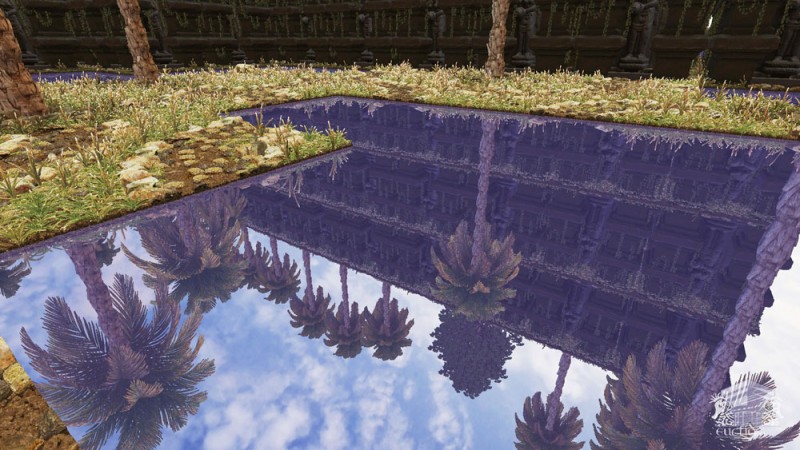
Adding a copy of the world to create this reflection doubled the object count, but doesn't slow the demo down one bit
Number One with a Rocket
In answer, Dell shows me an as yet unreleased demo – not
real-time in this case – that suggests Euclideon has already made some positive
inroads in ensuring Unlimited Detail is compatible with existing middleware.
The short video shows traditional polygon objects happily coexisting and
interacting in the same space as a small Unlimited Detail environment.
"This demo is for all those who say 'oh, it's halfway done, this is only good for static backgrounds – I bet they can't finish the second half,'" says Dell. "This here is a polygon rocket interacting with an unlimited detailed background. Here you can see polygons interacting in a way that shows that they know the other is there. You can see the light of the [Unlimited Detail] tree going around – that's actually the graphics card lighting it. So the graphics card is so compatible with the polygons converted to atoms that it thinks they're perfectly normal and is able to do the lighting with them."
The implications of this are, if Euclideon absolutely stopped today or, as Dell puts it, "the heads of the company were to die in some horrible accident and this was as far as the tech got," then this half-finished version of Unlimited Detail would still be of great use to developers. "You could still just take polygon objects and use them with unlimited detail backgrounds and you'd still have a big improvement over what exists."
It's hard then not to be enthusiastic about what Unlimited Detail could mean for the fidelity of graphics. I must admit that I was very impressed with what I was shown, and even though I poked and pried as much as I did onscreen, I couldn't find any telling cracks to suggest a facade. Likewise, I could detect no duplicity in Dell himself: he answered "what questions his benefactors would allow" in a very confident, candid, and forthright manner.
The technology also has the potential to give Australia a much larger role to play in the games industry. Dell hopes Euclideon will continue to get bigger and bigger. "If Australia can't compete in terms of programming and art because our dollar is too high compared to the US or China, then we can still lead in other ways," insists Dell. "It's sort of like in the US where they [don't build], but they still design cars – they've managed to retain some control that way. Likewise, with the games industry having all the problems it's had, if in the future it becomes impossible to profitably make a game in Australia, then we can take a new place as the ones who are making the technologies used in games. If we can do that we have a good future ahead of us and that's pretty much why the government gave us the grant."
It's an optimistic, but not unwelcome, take on things. But the fact remains that Unlimited Detail is an extremely promising, yet unfinished product that's built in such a fashion as to fly in the face of convention and the way traditional 3D engines are constructed. Who else but Dell can say with authority what will be possible, or impossible, when it comes to completing the second phase of his work?
Whatever the case may be, Euclideon is ready to back up its claims with a fully functioning product in less than a year. When that nebulous point in time arrives, the world will finally know whether or not a bold new future of game graphics has arrived with it.

Lingering Questions
In addition to walking us through out hands-on demo, Dell was happy to answer our remaining questions (to the extent he was allowed to), which shine a little more light on what Euclideon's engine is capable of.
Is Unlimited Detail format specific?
"We have what we call 'universal scalability.' Currently, if
you make a game on the PS3 with some characters, then you can't reuse those
graphics for the Wii because the polygon count is too high. An example of this
would be Force Unleashed: they needed a few different companies to make three
different versions for each system because Darth Vader and his Stormtroopers
couldn't be reused on a lower system. And certainly not for the DS or the
mobile phone from that PS3 original, either."
"However, point cloud data scales as easily as a bitmap image. So when people ask me 'will developers use this?' – and obviously I can't tell you what our situation with developers is – I say, 'of course!' Let's just say, if you were a developer, and you had the choice of using converted polygons in unlimited numbers and you only had to make the game once because you could rescale it to all the platforms, would you not want to use it? Especially if you know that your opposition is."
What effect will this have on the graphics arms race?
"As much as some media articles are saying we're going to be
the death of GPUs, we are on friendly terms with at least one of [the big GPU
companies]. The other, I just haven't had the meeting with yet. They have said,
'come on in,' though. GPUs used to be fighting one another for more power,
memory, and so forth, but now they have their languages like Kuda. I think the
concern for them was if we pushed software alone, then we would be a legitimate
'unfriendly.' But by us saying that we are going to put it on their graphics
cards and that there would be additional features...so if this was software
alone, but you had the graphics card and you ran it at 4069 or 8192 – resolutions
we've never heard of – there are legitimate benefits, and thus they'll sell
GPUs. So it's not as hostile as some media reports suggest."
If laser scanning real-life objects becomes the norm, will
this system make traditional artists redundant?
"We find most artists are happy with the idea of fiction and
non-fiction, where what can be scanned in should be scanned in. But then there
will always be Super Mario, aliens, zombies, and what not that will still need
to be built. The artists we speak to seem to be quite happy with that."
How compatible is producing content for this engine with
existing skillsets: like an artist who is trained to use Maya and 3ds Max, for
example? How would they go about producing content?
"Well, the type of tree we have now was made in 3ds Max. The
center part is scanned in, the branch is really a twig, and it was just
collaged in 3ds Max and Maya. Stuff that is scanned in can be converted to
polygons very easily, so we now have 100% translation from 3ds Max, and we're
moving onto Maya and ZBrush. Even the bump maps: we're actually taking that
height information and we're raising up the geometry and adding extra atoms to
it. So yes, we're completely compatible.
Do you see this being compatible with existing middleware,
such as Havok?
"I'm not allowed to comment on if we're already talking with
people in that particular area [smiles]. But yes, it is our aim to
join up with existing middleware."
Popular Content


![Remedy Explains Control Resonant's Most Memorable, Unexpected Sequence And Its [REDACTED] Inspirations](/sites/default/files/styles/teaser_promoted_image_thumbnail/public/2026/06/04/6db2d411/control-resonant-sgf-2026-7.jpg.webp)


Make Your
Bad signal or dead zones? Download your issues before you leave and read anywhere.


