Please support Game Informer. Print magazine subscriptions are less than $2 per issue
Good Choice: Morality and Dragon Age II
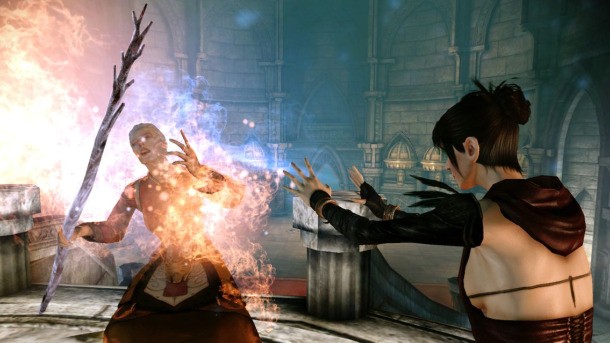
We have been making choices in games for years. Whether you’re earning Light Side points or racking up bad karma, morality in gaming has traditionally relied on the extremes of good and evil. Dragon Age: Origins successfully presented a world full of choices that went beyond traditional black-and-white options, and Dragon Age II will continue the trend.
During our visit to BioWare’s Edmonton studio, we sat to chat with Dragon Age II executive director Mark Darrah about the team’s approach to morality in its fantasy universe. Of course, Darrah didn’t want to spoil any of the tough decisions players will have to make as Hawke in Dragon Age II, but he did discuss the philosophies that guide the creation of significant, memorable choices – without resorting to the simplified good-or-evil dynamic.
One reason why Origins could take a more nuanced approach to decision-making was the elimination of a feature that BioWare itself had helped popularize: the morality bar. You’ve undoubtedly seen one before – a scale with good and evil at each end, and a slider that moves according to the nature of your actions.
While it’s fun to see concrete evidence of your choices, the morality bar imposes a restriction on them, too. It requires that every choice you make be classified as good or evil, leading players to behave as ruthless despots or selfless paragons, but without much room for anything in between.
“The thing about the morality bar is that it gives players a choice, but it simplifies it,” says Darrah. “It’s like watching a cartoon, to a certain degree. I’m not saying that as a bad thing – it makes the choices a bit easier without taking the choice away completely.” 

Like Origins, Dragon Age II won’t use a bar to gauge your moral progress, because the situations Hawke will encounter in the Free Marches fall into more of a gray area. Players won’t always be choosing whether to save a burning orphanage or watch as the flames devour it; the pivotal decisions are interesting because there is no clear correct path – just action and consequence.
“When the team starts applying their own morality to the system, then you’re forcing the player onto your morality,” Darrah explains. “We’re not forced to make the call between good and evil, and we’re not forcing you to make that call. Do what you think is appropriate, and there will be consequences.”
Think back to Origins’ situation with the possessed boy, Connor, in Redcliffe. Only one of the available paths has a pleasant outcome, and it is the hardest to achieve. All other avenues result in the player having to sacrifice something – and when weighing the life of a mother or that of her son, it’s doesn’t feel like morality has much to do with it. “Games with a stronger morality illustration, you can’t really give me a choice that’s hard,” Darrah explains. “If I can see both sides of it, it’s much harder to call one of them good and one evil.”
So, how does BioWare create situations where all of the options seem viable? By creating believable – though not necessarily realistic – characters who have their own goals. If the player is able to understand why a character wants something, it becomes more difficult condemn that character’s actions
“There are no moustache-twirling villains,” says Darrah. “They think they’re good. They all think they’re doing something for the best reasons. They may be wrong, but they think they’re doing things for the right reasons.”
An excellent example of a complex character from Origins is Teyrn Loghain. While his betrayal at Ostagar seems sinister, his actions make sense once players learn more about him. He remembers a time when Ferelden was controlled by the Orlesians, and he was the hero of the war that drove them out. He loves his country, and will do anything to ensure it doesn’t fall again to foreign conquerors. His history with Orlais may have blinded him to the real threat, but even in his apparently insidious actions during the course of Origins, he was doing what he thought was best for Ferelden.
Good and evil are not absolute. Loghain did evil things with good intentions, and players in Dragon Age II will also have to consider not only their actions, but their reasons for taking them. “Ultimately, evil comes down to motivation at the moment,” says Darrah. “A lot of games tend to punish or reward you based on outcome as opposed to minute-to-minute motivation. ‘Why are you doing this?’ ‘I’m doing this because I want the money.’ Well, that’s kind of an evil thing. To my mind, it doesn’t really matter if you’re saving the saving the orphanage because you want the money. That’s still an evil decision, even if you saved the orphanage.”
Not every choice Hawke makes in Dragon Age II will change the balance of power in the Free Marches. Like Origins, players will face decisions on multiple tiers, affecting anywhere between one life and hundreds. However, the size of the choices isn’t necessarily what makes them interesting. Instead, it’s the context around them – the characters, the goals, and the consequences (big and small). This is one of the areas where Dragon Age: Origins was strongest, turning morality into more than a tug-of-war between good and evil. Dragon Age II will continue to develop this signature aspect of the series, and as one of the studios that helped refine the concept of choice in gaming, BioWare undoubtedly has more compelling surprises in store.
I’d like to ask you to support Game Informer’s continued coverage of games with a subscription. For less than two dollars per issue, we mail you a full year of 10 print magazines, each with cover stories and preview features filled with exclusive details about the most exciting upcoming games. We profile and interview game creators. We look back on the rich history of gaming, and we celebrate what’s next.
Here on the website, we offer much of our content for free, including game reviews, daily news, videos, event coverage, and more – all with minimal ads.
We do so with a small editorial team, alongside contributing paid writers from around the world – over 65 individuals from 9 countries around the world, just in the last couple of years.
It’s not possible without support.
In a time when game makers and games coverage have faced hard struggles and layoffs, the future of this 30+ year magazine and community is at risk. Our new standalone magazine subscription is the number one way you can keep us alive – and we believe you’ll get a pretty fantastic gaming magazine in your mailbox every few weeks for your trouble.
Thank you.