Please support Game Informer. Print magazine subscriptions are less than $2 per issue
Social Commentary In Bioshock

As video games evolve, so too do the ways stories can be told. Developers have used their games as a means to express their own opinion, as well as commentary on a wider scale, lending more meaning to their narratives.
Bioshock Infinite’s cover was recently revealed, further exciting the gaming community. The anticipation is undoubtedly due largely to the fact that they’re expecting more of what the original Bioshock provided: a unique story with ample social commentary.
Objectivism In A Crumbling City
Bioshock’s antagonist, Andrew Ryan, is known for his soothing voice and unpredictable nature. But past his surface features, allusions both obvious and subtle connect him to famed author Ayn Rand, creator of the objectivist philosophy.
Objectivism places the advancement of the individual over the needs of others. Without the hindrance of outside influence, Rand preached a philosophy in which society was based around a small group of elites who sought to gain more influence for themselves. By doing this those people would drive society forward. This form of pure capitalism is constantly represented in her novels; her characters usually exude these sentiments as well.
Aside from the fact that Andrew Ryan’s name is a partial anagram of Ayn Rand, the duo’s beliefs mirror each other’s as well. Ryan’s looming bust gazes down on you as you arrive in Rapture. A banner sports the slogan, “No Gods Or Kings. Only Man.” As the story of Bioshock progresses, it becomes painstakingly clear that much of what happened to Rapture was due to the chaos resulting from Ryan’s ideals.
The city itself was built as a place to practice objectivism. The inhabitants are all able individuals primed for success and discovery. Without the interference of government or people concerned with the greater good, Ryan created a place where he thought the elite could flourish.
Another tenet of objectivist ideals is reason. Ryan places this tenet above all else, as referenced by his hatred of religion, socialism, and altruism, or the belief that humans have the responsibility to help other humans. Ryan, like Rand, believes that society would expand and progress if everyone were to worry only about their own well-being.
Whereas economy, government, and industry unite the people in the real world, Ryan used them to provide the foundation for a society that could flourish with reason and self-advancement. These tenets sparked the civil war that the player witnesses upon arrival in Rapture. Ryan and Rand both advocated a free economy devoid of any intangible beliefs; in the case of Ryan, this eventually led to the downfall of his city. 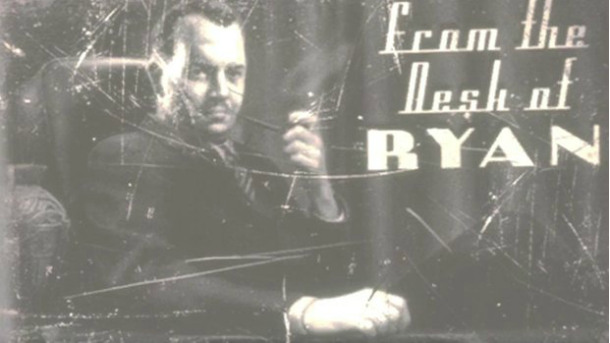
Tunnel Vision In Video Games
Close-mindedness is also a unifying factor between Rapture’s creator and Rand. Both of them believe that it was “[their] way or the highway,” Ken Levine, creative director at Irrational Games, said in an interview with Kotaku.
“…I was setting out to make a game about someone who had a very strong belief in a philosophy.”
“It is a cautionary tale about wholesale, unquestioning belief in something,” Levine said. Like Rand, Ryan is set in his views. This concrete focus is what led to the downfall of Rapture. Because of his unwavering beliefs and his refusal to compromise, Ryan indirectly destroyed his own creation.
Levine used Ryan and, ironically, the players themselves to show the danger of accepting a truth without question. Not only are you shown how a static belief can affect society – you experience it firsthand.
“Ayn Rand’s heroes have no flaws,” Levine said after Bioshock’s induction into the Art of Video Games Exhibition. “Let’s take these philosophical notions and put them in a world where things can go off track.”
Things definitely go off track in Rapture.
Through all of the chaos of a collapsing city, Ryan’s assuring voice guides you along. Games have conditioned us to automatically trust what is being told, so long as it advances us toward the end. Like Ryan, we’re blind to outside influence. When it’s finally revealed by Ryan that we’re brainwashed, it’s too late to react. He has a hold on us; only then do we regret the habits that decades of video games have instilled in us. In this way, we’re lumped in with Rand; we accepted something without consideration.
Bioshock asks the player to question the game, rather than follow it blindly out of habit. Like Rand, both the player and Ryan are guilty of the latter. Through the use of an interactive narrative, Bioshock made us examine the rules of video games much like people have questioned the ideas of Rand.
“I started to wonder, what happens when you start questioning yourself?” Levine said. “It becomes a set of accepted truths, instead of something you’re constantly using in the lab of reality.
“I think by trying to throw some reflection on it you make people step back from the games they’ve played and think about it a tiny, tiny bit.”
I’d like to ask you to support Game Informer’s continued coverage of games with a subscription. For less than two dollars per issue, we mail you a full year of 10 print magazines, each with cover stories and preview features filled with exclusive details about the most exciting upcoming games. We profile and interview game creators. We look back on the rich history of gaming, and we celebrate what’s next.
Here on the website, we offer much of our content for free, including game reviews, daily news, videos, event coverage, and more – all with minimal ads.
We do so with a small editorial team, alongside contributing paid writers from around the world – over 65 individuals from 9 countries around the world, just in the last couple of years.
It’s not possible without support.
In a time when game makers and games coverage have faced hard struggles and layoffs, the future of this 30+ year magazine and community is at risk. Our new standalone magazine subscription is the number one way you can keep us alive – and we believe you’ll get a pretty fantastic gaming magazine in your mailbox every few weeks for your trouble.
Thank you.