Decrypting The Elder Scrolls

In light of our upcoming cover story on The Elder Scrolls V: Skyrim, we take a look back at the storyline and development of the role-playing juggernaut series.
The tale of the Elder Scrolls began in recent years for many fans, as they explored the massive nation of Cyrodiil in The Elder Scrolls IV: Oblivion. However, that popular entry was only the latest chapter of a sprawling epic that began way back in 1994. As we prepare to help Bethesda unveil the first look at the next installment, entitled Skyrim, we decided to look back at both the in-game and out-of-game stories that have shaped these incredible role-playing experiences. We asked longtime Bethesda developers to share their knowledge and memories, and present the history of the Elder Scrolls here as told by the people who made the series happen. We’ve split their responses into two major sections. Page 1 and 2 include the team’s reflections on creating the game, and the major technology changes that fueled each entry. Page 3 and 4 include a detailed look at the fiction and lore of the Elder Scrolls universe – a perfect place to start before learning about the intriguing storyline of Skyrim, which we’ll begin detailing in our February issue.
NOTE: A version of this article originally appeared in Game Informer issue #213
Developing the Elder Scrolls
The Elder Scrolls: Arena (1994)
One of my first jobs at Bethesda was helping with the CD‑ROM version of Arena in 1994. Every time there was a new build, I took it upon myself to finish the main quest. I can probably finish that game faster than anyone. The “Passwall” spell, which lets you literally carve your own path through dungeons, is still cool. – Todd Howard, Game Director
Arena used a raycast engine that we developed, that was similar, but more advanced to the one used in The Terminator: Rampage. It had a massive world, most of it randomly generated using seeded tilesets. Daggerfall used a similar building system, but in true 3D. – Todd Howard The Elder Scrolls Chapter II: Daggerfall (1996)
Daggerfall in my memory is mostly flavored by how large it was. It was something we really struggled with during the project. We were never sure if it was big to just be big, since it was randomly generated. We could dial up or dial down the size very easily. But it became the sum of its parts. You could do so much. It’s also the Elder Scrolls game that introduced the skills system, and the whole “you improve by doing” paradigm, which I think defines the series in many ways. You really felt like the character you played was up to you, and not the game. – Todd Howard
It was 1995 and we were working on Daggerfall. We were building out the small shrines that were randomly sprinkled around the Iliac Bay. I happened to travel to one around sunset. The bright orange wisps framed the crumpled entrance to a hidden shrine. I thought to myself, “***, this game looks amazing.” Little did I know what the future held. – Bruce Nesmith, Design Director
Daggerfall initially was developed using an updated Arena raycast engine similar to Doom's, where the world is really 2D and drawn to look 3D. We then decided to begin development of one of the very first true 3D engines – the XnGine. This engine would go on to power other titles such as The Terminator: Future Shock, SkyNET, X-Car, Battlespire, and Redguard. The Terminator Future Shock, was the first game to use the engine, and also the first PC game to use the now popular mouse-look interface, though at first, people didn’t like it. The basis of the XnGine, and its world building, is still the basis for how we build today. – Todd Howard
I was hired during the final throes of Daggerfall’s long development. Nobody had a lot of time to train or supervise me, so I was pretty surprised to be this brand new rookie designer basically doing whatever I wanted. Luckily I was still young and responsible, so I didn’t take (much) advantage of my freedom. This was also my introduction to the magic of game development – I still remember my amazement at being able to put together a dungeon or quest, fire up the executable, and see what I’d just done right there on my computer screen in an actual game. I’m still occasionally floored by that magic, even after all these years. – Kurt Kuhlmann, Senior Designer
The Elder Scrolls Adventures: Redguard (1998)
Redguard is still my favorite game that I’ve worked on. Todd, Michael Kirkbride and myself worked up the story and all the puzzles over a few weeks of continual brainstorming. I’m pretty sure Fuddrucker’s was heavily involved in the process. Because the team was so small, I ended up doing a bit of everything on that game – I even built a few levels in 3DS Max, which is the first and last time I got art credit on a game. – Kurt Kuhlmann
Redguard was the last of our XnGine games, and one where we really worked on building the world by hand, as opposed to the random generation of Arena and Daggerfall. It also had 3Dfx hardware acceleration, and was our first hardware based 3D game. It was one of the last popular DOS based titles, just as Windows gaming was getting popular. The 3D acceleration only works in 3Dfx’s glide system. – Todd Howard
Next up: How the later games in the series were developed

Morrowind represented another quantum leap forward for the series in complexity and scope
The Elder Scrolls III: Morrowind (2002)
Morrowind was a real reboot not just for the Elder Scrolls, but for Bethesda. We built a game while building up a development team. We had shrunk to maybe 6 people in development, and this was probably our last chance. I coded the initial demo of the game by myself and designed the editor when we started. I felt the whole game hinged on having a great tool we could build and tweak the game with, and The Elder Scrolls Construction Set was born. I took the name from the Apple 2 program, “Stuart Smith’s Adventure Construction Set.” To this day, I think what the modders have done with those tools has helped define the series. – Todd Howard
Morrowind was a major rewrite of the whole system, using world building techniques we had used in Redguard, but on a massive scale. The whole engine was redone again. Everything was built by hand, and now with the advances in 3D, we could build everything from forks to pillows to giant castles. This game also marked our first foray into the console world with Xbox, whereas before we were just a PC developer. – Todd Howard
The Elder Scrolls IV: Oblivion
We started in 2002 with Oblivion, right after Morrowind. The easy thing would have been to do a 2 year sequel, but I somehow persuaded upper-management to let me take four years and make a next gen game for consoles that didn’t exist yet. That was a stressful time, since we only had final hardware for maybe the last 6 months. So almost all of Oblivion’s development was spent thinking, “I’m not sure this is ever going to actually work.” I was really influenced by the Lord of the Rings movies at that time. It felt real, almost historical, and that’s something I think is key to The Elder Scrolls. – Todd Howard
Todd Howard asked me to create and present a quest line for the Thieves Guild. I put together a rambling presentation of the 20 quests I had planned. In the meeting I got one sentence out before Todd stopped me. “Tell it from the player’s point of view,” he said. I had gotten so wrapped in my back story I was telling that rather than the player’s story. By the end of the day, almost half the quests had been cut, making it much better. Since then, I’ve never forgotten that we make stories for the player, not for ourselves. – Bruce Nesmith, Design Director
E3 was coming up and we were scrambling to get the Oblivion demo done in time. The plan was to show a detachment of Imperial soldiers attacking an Oblivion gate. It was close to being polished and I was feeling pretty good. This was Friday night and the demo needed to be ready early the next week. Then Todd called me over to see something that Istvan Pely had prototyped – a fight through a ruined city. Todd: “This is what we’re doing. How long will it take you to get it working?” Me: “…….” (I may have yelled something unprintable as I walked out of the office.) It turned out to be the right decision – this was the Kvatch demo we showed at E3, and the original Legion fight ended up in the game as a random encounter near an Oblivion gate. – Kurt Kuhlmann

Previous entries in the Elder Scrolls series sold well, but Oblivion soared to new commercial heights
I’ve always found it interesting that the art style for each game is a direct reaction to the previous game. After finishing Morrowind I wanted to take the Elder Scrolls in a more realistic direction, with some high fantasy elements. I brought this to Todd’s attention and surprisingly I found out we were on the same page. Similarly, at the end of Oblivion I felt the art style could go in a completely different direction, which drove the look for Shivering Isles. Once again, Todd was excited about a stylistic change and we ended up with our most unusual aesthetic since the Elder Scrolls series began. I think changing the visual style between games helps keep the series interesting for us as developers and for the people who play it. – Matt Carofano, Art Director
Oblivion featured another engine update, using parts of Morrowind’s base, but with a new renderer, a new face system, real physics, moving trees, and more. We went all out technically as we were now working on and pushing the latest generation of hardware. This was a four year project we started long before we knew what an Xbox 360 or PS3 would even look like. Some other innovations here are the Radiant AI system, which allowed our NPCs to do what they wanted, explore the world, and be much more dynamic based on their surroundings, as opposed to just acting like “menus” as they did in the previous games. –Todd Howard
Next up: The story of the Elder Scrolls games, from the beginning until now

With the exception of some side trips to the plane of Oblivion, the Elder Scrolls games have all taken place on the continent of Tamriel
The Lore of the Elder Scrolls
“We’ve always treated the world of Tamriel as a real place, a place you can make a difference in. It’s the connection of the people, the Empire, and their gods. How does one affect the other? Do we, the people, hold our destinies in our hands, or are we part of something larger? That idea is embodied in the Elder Scrolls themselves, which speak of the past, present, and future in one voice.” – Todd Howard
Each entry in the series ties into a single deeply intertwined story. Senior designer Kurt Kuhlmann walked us through the installments and how each connects to the next.
1. The Elder Scrolls: Arena (1994)
“Emperor Uriel Septim VII is betrayed by his battlemage, Jagar Tharn, and imprisoned in a realm of Oblivion. The player travels across Tamriel searching for the pieces of the Staff of Chaos in order to rescue the Emperor and defeat Jagar Tharn.” Impact? “During Jagar Tharn’s reign, the Empire was weakened by a series of wars, one of which plays into the story of Daggerfall. More details of Jagar Tharn’s plot against the Empire were revealed in Battlespire.”  2. The Elder Scrolls Chapter II: Daggerfall (1996)
“The player is sent to the city of Daggerfall by the Emperor…[The player recovers] the Totem of Tiber Septim, the key to controlling the Numidium, a giant golem used by Tiber Septim to forge the Empire hundreds of years before. The game has six different endings depending on who the player chooses to give the Totem to.” Impact? “The game ended with what became known as ‘The Warp in the West,’ with the six possible endings all happening or not happening simultaneously.”
3. Battlespire: An Elder Scrolls Legend (1997)
“Set during the same time as Arena, the player is an apprentice battlemage who gets caught up in Jagar Tharn’s betrayal of the Battlespire to the daedra lord Mehrunes Dagon.” Impact? “Battlespire sets up Mehrunes Dagon as an enemy of the Septim Empire, and his defeat provided him the motive of revenge in Oblivion’s story.”
4. The Elder Scrolls Adventures: Redguard (1998)
“Unlike other Elder Scrolls games, in Redguard you play a particular character, Cyrus, who travels to Stros M’kai in search of his missing sister. In the process, he gets caught up in Tiber Septim’s attempted conquest of Hammerfell. In the end, Cyrus rescues his sister and drives the Empire off of Stros M’kai.” Impact? “The Empire withdrew from Hammerfell after its defeat at Stros M’kai. Later, Hammerfell joined the Empire voluntarily in the Treaty of Stros M’kai, negotiated by (now) Queen-Regent Iszara.”
Next up: The final developments in the Elder Scrolls story before the upcoming Skyrim game

Bloodmoon was one of several expansion packs that continued the experience beyond the core games in the Elder Scrolls series
5. The Elder Scrolls III: Morrowind (2002)
“The player is a prisoner, sent to Morrowind by the Emperor ostensibly to work as an Imperial agent, but in fact to help investigate and perhaps fulfill a prophecy and become the reincarnation of the Nerevarine, a long-dead hero. You learn the origins of the Tribunal, the revered god-heroes of Morrowind, and their struggle with the immortal Dagoth Ur. Dagoth Ur and his Sixth House cult are the source of a supernatural blight that threatens to overwhelm Morrowind. By fulfilling the prophecies, the player is finally able to confront and defeat Dagoth Ur in his fortress in the crater of Red Mountain.” Impact? “When the Heart of Lorkhan was released from the mortal plane, the power of the Tribunal was broken forever, which indirectly led to the fall of the Ministry of Truth and the devastation of Vvardenfell (as described in the novel The Infernal City).”
6. The Elder Scrolls III: Tribunal (2002)
“The player is put in the middle of a struggle between Almalexia, one of the members of the Tribunal, and the ruthless King Helseth. The player is eventually sent to deal with the threat of the crazed Sotha Sil, but in fact it is Almalexia who has gone insane and has to be destroyed.” Impact? “With the death of two of the members of the Tribunal, the authority of the Tribunal Temple is unlikely to survive. This may herald the return of the Dunmer to their ancient tradition of daedra-worship.”
7. The Elder Scrolls III: Bloodmoon (2003)
“The player learns of the Bloodmoon Prophecy, in which the daedra lord Hircine stages a ritualistic hunt. The player joins the Skaal tribe and eventually becomes the prey of Hircine’s great hunt, possibly becoming a werewolf along the way.” Impact? “Nothing substantial changed, the story was more personal to the player.”
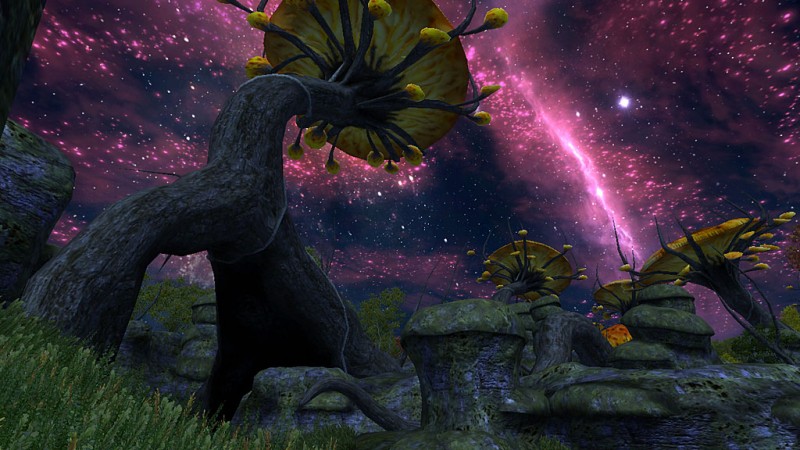
Shivering Isles was a visually startling setting after the familiar forests and mountains of Oblivion
8. The Elder Scrolls IV: Oblivion (2006)
“The game opens with the assassination of Emperor Uriel Septim VII by unknown assassins…The player has to find Martin Septim, the last heir to the Septim throne, and help him relight the Dragonfires in order to stop Dagon’s invasion. In the end, Martin is forced to use the Amulet to take the form of the god Akatosh in order to defeat daedric prince Mehrunes Dagon.” Impact? “Martin’s apotheosis permanently sealed the barriers between Oblivion and the mortal world, forever preventing the kind of invasion attempted by Mehrunes Dagon. The end of the Septim Dynasty heralded the end of the Third Era. The fate of Tamriel and the Empire in the Fourth Era remains to be seen.”
9. The Elder Scrolls IV: Shivering Isles (2007)
“A mysterious gate opens on an island in the Niben Bay. It leads to the realm of the Daedric Prince of Madness, Sheogorath, who is looking for a mortal champion to help fight the onset of his nemesis, Jyggalag, the Daedric Prince of Order. In the end, Jyggalag and Sheogorath turn out to be one and the same – Jyggalag was cursed long ago by the other daedric princes to be Sheogorath. By defeating Jyggalag, the player breaks the curse and assumes the mantle of the Prince of Madness.” Impact? “Jyggalag is now freed from his curse of madness. Although defeated, he will eventually resume his place as the Prince of Order, with unknown ramifications for the complicated and opaque balance of power within Oblivion.”