Storytellers Of The Decade: Corey May Interview
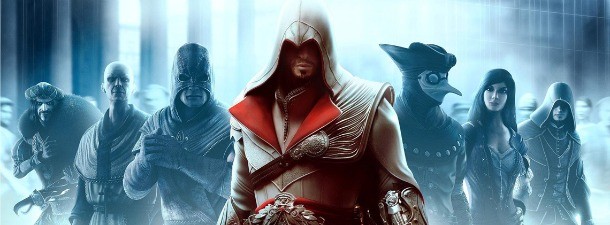
We asked the writer of Assassin's Creed to explain his thoughts on interactive narrative, characters, and his favorite game stories.
As part of our cover story on this decade's 30 greatest characters, we chose several creative voices from across the gaming world that have contributed profoundly to the growth of storytelling in the medium. After careful deliberation, one of the storytellers we chose was Corey May, script writer for Assassin's Creed 1 and 2. We asked May several questions about the way he understands story and characters within games, and he had the following to share.
In what ways does storytelling in games differ from in other mediums? More specifically, how does the inclusion of player interaction alter the way you approach plotting, character development, and thematic concepts?
For me, medium does not impact the story being told. At most, it will impact the way the story is told. I think there is a distinction here. So player interaction doesn’t consciously impact the approach, but it may have an impact on some of the execution. The actual stories told in the various Assassin Creed games are determined by ideas we have, places we want to go, themes we want to explore, characters we want to create, fantasies we want to experience. If these things are influenced by the medium, it’s subconscious. It’s not intentional. But that’s just me. Other writers may have other methods or approaches. So this is just how I work. I don’t intentionally incorporate the medium into the narrative. When Minerva looks at Desmond at the end of AC2, maybe that’s commentary. Maybe it’s a suggestion she’s looking at the player. But the player IS Desmond. So make of that what you want.
Interactivity still has an influence. With Assassin’s Creed I’ve been very fortunate. You are – for most of each game – reliving an experience. It is predetermined. It’s mostly linear. For moments when it isn’t, it’s simply a matter of creating multiple versions of a scene. So it’s additional work – accounting for the possible player (or environmental) inputs – and then writing accordingly. But it’s generally binary. So for a handful of scenes I’ll write two versions instead of just one. A scene for case A and a scene for case B.
When we’ve discussed introduced increased variability, it definitely has an influence on plotting. I find myself favoring a far simpler main narrative – ensuring there are a few major main beats and then wide gaps where you tell lots of little stories that are self-contained, but don’t create too much insanity at choke points. The focus tends to shift from telling an overarching stories to telling lots of little stories that color in the world. People can only track so many threads at once so you can’t overcomplicate your main narrative if you’re going to offer tons of choice in between major moments.
What different skills are required for someone writing in games or someone writing for movies or TV?
If you’re going to write a game YOU NEED TO KNOW GAMES. I can’t stress this enough. You need to play games. You need to understand how games are made. You need to recognize it’s an intensely collaborative process. You have to be willing to work harder. You can substitute work harder with the word compromise. But you MUST KNOW GAMES. I know this sounds like it should be obvious: know and enjoy the medium you work in. But I have encountered several people working as game writers who don’t play games and that’s weird to me. Because games are so collaborative you have to understand them – so that when a designer (mission, level, gameplay, etc.) comes to you with an issue or an IDEA – you understand why they’ve come to you – and can find a way to address their concern.
I think you also need to love games. I don’t know – maybe there are amazing game writers out there who hate games and don’t play them. So maybe I’m wrong. But that’s definitely weird. If you aren’t interested in games, why are you working on them? I don’t like writing. I hate it. I hate putting myself out there. But I love games more than I hate being vulnerable.
What do you think of the recent spate of video game movie releases and upcoming movies? Is there still a disconnect between Hollywood and the gaming industry? Is it getting better or worse?
I’d say: status quo. I think adaptation decisions are still primarily driven by the source material’s revenue and not content. I’m skeptical and cynical. I absolutely think there’s a disconnect between Hollywood and the gaming industry. I think that history is littered with missed opportunities, ignorance, arrogance and greed. I think Hollywood is disrespectful towards the gaming industry. I think it’s viewed as: an ancillary market, a well of source material to be “fixed”, or the realm of those who couldn’t hack it in showbiz. How can anything interesting or meaningful be borne of a relationship if you start from such a dismissive position? Give it time, though. We’ll reach a point where the people in positions of power understand and respect games.
But on the flip side it doesn’t help that some people in the game industry are opportunistic and bitter. They see games as a means to an end. Games aren’t “good enough”. They aspire to make their games more movie-like. I don’t know what that means. Stop talking about cinematic experiences. Focus on making games. If you don’t want to make games then stop making them. You want examples of “interactive cinema”? Uncharted 2. Bioshock. Portal. Closest we’ve come. Fantastic stories + fantastic gameplay. Win. I love these games. I love Valve and Irrational and Naughty Dog – because they appear to EMBRACE what they are – video game developers. They don’t prioritize gameplay over story or story over gameplay. They focus on the whole thing. The experience. If I can someday be half as talented as the writers working at those places, I’ll be happy. That’s why I love working for Ubisoft. They let me aspire to that. They encourage it. But even their support may not be enough. Just ask Victrix on neogaf. When it comes to Assassin’s Creed this is what he had to say: “The entire over-arching storyline is one of the most embarassingly awful bits of writing I've had the displeasure of experiencing in any medium [sic].”
Anyway, I don’t pretend my answer is any kind of truth. Maybe I’m right. I’m probably wrong. Or I’m forgetting something. But whatever the case, there’s definitely a disconnect. Both sides are responsible. Fix that *** and who knows what amazing things might happen.
Next up: Corey May's favorite game stories and characters
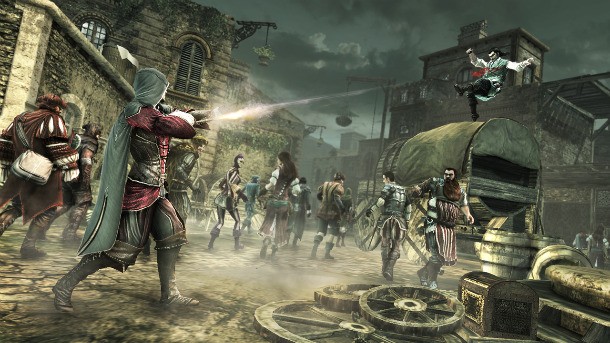
In your experience, does story more often emerge from an existing gameplay mechanic, or vice versa? How about in the case of Assassin’s Creed? Did the free-running and climbing mechanic precede the concepts of the Assassins and the Templars, or the futuristic Animus?
It all happened together. The way it should. Patrice would be the best person to ask this question. A desire to create the experience of being an Assassin probably came first. Patrice had a time and location in mind: the Crusades. The Templars were a natural extension of that. The Animus was an evolution of the story-teller mechanic introduced in Sands of Time. A way to frame the experience in a way that justified the game-y aspects and also broadened the universe’s potential. But it didn’t happen according to some mathematical formula. It was a shared vision of an experience that just grew into Assassin’s Creed. I wish I could be more specific. If I could then there’d probably be a way to plug variables into a program and spit out something cool.
But that’s just how Assassin’s Creed was (maybe?) born. I don’t know if that’s true for many/any/most games. I get the sense that sometimes things are created from less abstract stuff: focus testing, feedback from marketing, licensing departments.
What do you see as the biggest technical advancement in recent years to the successful implementation of story in games? Regular voice acting or high-end musical scores? In-engine cinematic events? Choice-driven role-playing events? Something else?
I think motion capture has been a big one – especially when it comes to subtler body language and facial expressions. Performance capture is interesting – combing motion capture and voice acting in one shot. The pool of available talent is small right now but it will grow. I also think a willingness to record multiple actors at the SAME time has been fantastic in terms of making in-game dialogue feel more natural and organic.
In what ways did you and the rest of the development team at Ubisoft want the Assassin’s Creed universe to stand apart from other game stories?
I don’t think we consciously approached it from the perspective of let’s make it stand apart. It was more what do we think is interesting. I don’t know. Maybe the rest of the team has different answers. But for me, I didn’t think about that. I just thought about the stuff I thought was interesting. And went with it.
What are your favorite game stories of the last 10 years, and why?
There are lots and there are so many different reasons for my love of them. Most recently Red Dead Redemption. They told a fantastic story starring a really compelling protagonist and set in an incredible world. But that’s a no-brainer. Everything R* is amazing. Bioshock for the personality of its villains, its clever commentary on choice in video games (re: “Would you kindly”), and the way it turned the environment into a character itself. I loved Portal both for GLaDOS and the fact that the end of the test chambers was just the beginning of the adventure. Fallout: New Vegas did an incredible job of creating a sense of discovery and adventure. Every single location I visited in the game told a different story and they all fed back into building this awesome world. Bioware’s ability to create deep and engaging characters is mind-blowing – so basically everything with Bioware’s name on it. I thought Arkham Asylum delivered so well on the promise of BEING a superhero. I literally got to be the Batman. I loved the Sandman sequences too. Really interesting way to make the character and player feel the same thing. I also found a lot to like in Prey. Half the things the protagonist said were things I was saying – at the exact same time. Also talk about an uncomfortable ending. Maybe it wasn’t perfect, but it resonated with me. I really enjoyed the earlier Silent Hill games, especially Silent Hill 2. Atmospheric and provocation. Eternal Darkness as well. I loved the way it played with perspective. But most interesting was the concept of the sanity meter – it really worked to tie your experience to that of the characters.
But my favorite is the one I wrote myself. Before everyone starts call me a self-important ***, let me clarify: I was playing a match of League of Legends. I chose Heimerdinger. I like defensive and support classes. So I took heal and clarity. The match starts and the other team is aggressive. As most familiar with the genre are aware, MOBA players can be real %#$*bags. No sooner has the match begun than someone on the opposing team shouts “What kind of Heimer takes heal, you &@$#ing noob!” As luck would have it I was LANing against him. About ten minutes in he starts getting very aggressive – wrecking my towers and chipping at my health. Then he basically tower dives and promptly starts to ruin me. I take a heal pot and throw down a turret. But he’s going to win. So I stun him with a grenade and slam heal. And he dies. So I say “THAT is the kind of Heimer that takes heals.” He didn’t open his mouth for the rest of the game.
I have dozens of similar stories from World of Warcraft. Everything from my first trip to Molten Core, to taking out Gruul before he was nerfed, to getting into my first raiding guild, to watching it fall apart, to being there when the server united to open up the AQ gates. These are game stories too.
Similarly, are there any particularly excellent game characters that really stand out for you in recent years?
GLaDOS, Legion and Mordin, Edwin, Andrew Ryan, Max Payne. I loved the Prince and Farah from Sands of Time. Jordan nailed it. I love Ratchet, Clank, and Captain Qwark. So many characters from Rockstar and Bioware games… I could go on forever. There’s so much great work being done by so many people. Oh, special mention to Laharl and Etna. When you spend hundreds of hours with two lunatics, they earn a special place in your heart. And a final extra special mention to The Great Mighty Poo. Easily the greatest boss fight in the history of everything ever. Forever. It will never be topped.
Where do you see game storytelling going in the coming decade? Are there new, untapped genres that games could successfully explore?
I don’t know. I wish I had a fancy answer. I think the most obvious thing to watch for it is increased cooperation between design and narrative. I imagine a future where the two reach a nice symbiotic parity and become fully intertwined. It is a natural progression. I feel like there’s still some growing to do in that regard. Why is there this tug of war? Why does gameplay have to be more important than narrative? Why do some people feel strong narrative is more important than good gameplay? Why aren’t we demanding and producing more games that insist both are equally important? Obviously I’m only talking about games that have narratives. Not all games have stories. Not all games need them. Not all games are better for them. Some are arguably worse. I just think if story IS an element of a game, this kind of evolution would be beneficial for all involved.
For more details on this month's cover story, and updated coverage throughout the month, make sure to check out this month's cover story hub.