
Opening The Portal: Exploring The Game's Development
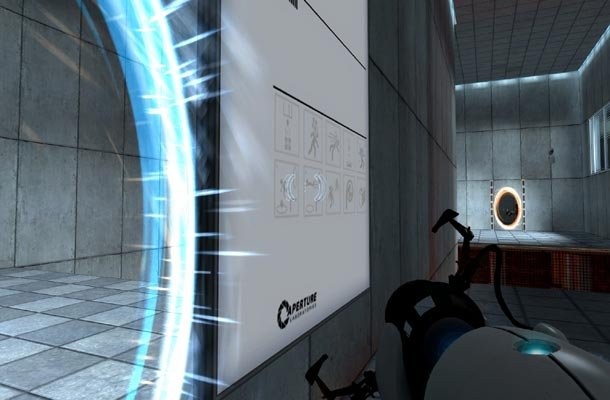
Experiments are a dangerous proposition. Valuable resources can be wasted if a creative idea is poorly implemented. At a glance, Valve’s 2007 release Portal might have seemed like a risky gamble. While it came from one of the most respected development houses in the industry, the actual team was small and the gameplay featured novel mechanics difficult to convey in simple screenshots. Even the creators didn’t know what to expect from Portal until it released – that’s when Valve’s experiment turned into a phenomenon.
The Half-Life Connection
Valve fans that played through Portal may have picked up on the game’s subtle references to Valve’s biggest franchise, Half-Life. GLaDOS mentions Half-Life’s Black Mesa in the closing song, and a Powerpoint presentation detailing the financial competition between Aperture Science and Black Mesa can be seen in the later sections of the game. Given that Portal and Half-Life have vastly different tones, the link between the two titles seems a little odd. Valve’s other major franchises – Left 4 Dead and Team Fortress – have received their own distinct settings, so why was Portal an exception? The answer is simple – it was a decision made out of necessity. But to understand the dilemma, we have to go back to Portal’s humble beginnings.
In 2005, Valve discovered a young group of students at DigiPen and took them under its wing. The young programmers had been working on a game called Narbacular Drop (for more on Narbacular Drop be sure to check out our video feature on the game) Valve supervised the team and paired them up with one of its newest writers, Erik Wolpaw, a veteran humorist from Double Fine and the website OldManMurray.com. Valve saw great potential in the student project, but it kept the Portal team small, because it didn’t know if that potential would be realized.
Because the Portal team’s resources were so limited (the core team was less than a dozen people), certain developmental concessions had to be made. For one, the team didn’t have enough artists on tap to create assets for a new world. “It seemed like it made sense to put Portal in an existing universe,” recalls Wolpaw. “Some of that was driven by the fact that we didn't have a big enough team to do the art from scratch, so we ended up reusing primarily Half-Life 2 art assets.” The two games may have been linked by a similar setting, but the team had a feeling that they should keep that link as understated as possible. As it would turn out Portal would be a vastly different title from anything Valve had done before.
From Black Mesa to the Orange Box
Finding Portal’s setting turned out to be the easy part. The Portal team knew they wanted their game to feel different than any of Valve’s other titles. They wanted to find a unique voice for their game; something that definitively set it apart from Half-Life. “At the beginning of the Portal development process, we sat down as a group to decide what school of philosophy our game would be based on,” explains Wolpaw. “That was followed by about fifteen minutes of silence, and then someone mentioned that a lot of people like cake.” Cake would be the answer; the team just didn’t know it yet.
Narbacular Drop was a whimsical game about a princess who used magic to escape from a demon’s mountain prison. It was amusing in its own way – the heroine’s name was Princess No-Knees, because she couldn’t jump. However Narbacular Drop’s whimsy was far from the more refined wit that Portal utilized. Another problem with Narbacular Drop is that it was only about fifteen minutes long; Valve would need to create a longer, more involved story that still centered on portal technology, but also tied into the Half-Life universe. It’s no surprise the solution didn’t come right away.
Wolpaw sat down and began drafting ideas for how to develop the team’s unique student project into a game that people might actually pay money to play. “We kind of had a complete game experience when we walked into it,” recalls Wolpaw. “So we were trying to find a way to, as a nondestructively as possible, develop the setting and figure out the narrative.” Wolpaw envisioned an advanced AI that was guiding players through a series of obstacle courses in an effort to test an experimental new portal gun device. “Humor was in our wheelhouse,” says Wolpaw. “And we kind of figured that's what Valve was hiring us for. We didn't think they were hiring us to write drama…so we just kept going with it, and we started play testing it, and it quickly became evident that this was the right direction to go.”
The first scene Wolpaw wrote was a sequence that actually takes place late in the game. As protagonist Chell approaches the end of the final test chamber, a polite AI program asks her to place the portal gun on the ground and assume the party escort submission position. The rest of the team loved the ideas presented in Wolpaw’s early draft. It was clear that these kinds of antics, and the Genetic Lifeform and Disk Operating System (GLaDOS), in particular, were a perfect fit for Valve’s new game. Portal had found its voice.
At the End of the Experiment There Will be Cake
The size of the Portal team may have limited the resources they had to throw at any given problem, but in other ways they were more liberated. Because Valve had kept the team small, they were free to explore experimental or risky ideas that might scare away a larger development team. For much of the game, these kinds of experiments panned out, but not every experiment produces expected results.
After the game released, Valve was taken aback by how many of the game’s jokes, such as “the cake is a lie,” exploded into cultural memes. “We had no idea those things were going to blow up like they did,” admits Wolpaw. In fact, one of the jokes that the team did think might become a big thing has been entirely forgotten. At the very end of Portal, after players defeat GLaDOS and are looking at the debris scattered across Aperture Science’s parking lot, a giant hoop slowly rolls into the frame. “We all loved that,” explains Wolpaw. “It was Hoopy the hoop. We thought we should have a warehouse full of Hoopy t-shirts and mugs and posters…we would watch that hoop roll by over and over again. That was the part of the game we were most proud of, and nobody cared.”
Hoopy probably just proves that development teams can get a little slaphappy as a game nears its ship date. But it also shows that one can ever expect what the wider gaming audience will latch onto; the mystery even extends to whether or not a game will sell. As Portal neared its completion, the company began to wonder what they were going to do with the title. Should they package it as a standalone game, or release it for download only? Since Portal was so much shorter than most retail releases, no one knew how much they could expect people to pay for the game. In the end, Valve combined Portal with Team Fortress 2 and Half-Life 2: Episode Two to create The Orange Box. Any fears Valve may have had that Portal would get lost in the crowd were quickly silenced once the game released, and many of the jokes Valve had forgotten about quickly became internet memes exchanged like secret handshakes.
Looking at the path it traveled from inception to release, Portal’s success is as unlikely as it is impressive. The game was short, goofy, and the small team’s first high-profile project. It even ended with a musical number – but it was exactly what gamers were looking for at the time. No one would have known that, however, if Valve hadn’t taken a chance on an experimental student project.
Be sure to check out all our Portal 2 coverage on our Portal 2 landing hub.


